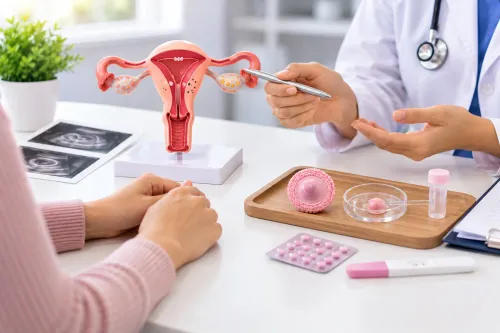

Waiting six or 12 months is reasonable for some people, but age, symptoms and medical history can make that delay costly. By comparing early evaluation with continued trying, you can identify when assessment protects your options, when treatment is premature and what questions to ask before choosing care.
Key takeaways
- Seek evaluation after 12 months under 35, or after 6 months from age 35.
- Book evaluation sooner for irregular periods, endometriosis, PCOS or prior pelvic surgery.
- Testing can identify ovarian reserve, ovulation, tubal blockage and sperm-related factors.
- Compare success reporting, treatment options, costs, timelines and emergency support before booking.
When does waiting to conceive become a disadvantage?
Fertility does not remain constant while you wait. It begins to decline gradually around age 32 and more rapidly after 37, as egg number and egg quality fall. Older eggs also raise the chances of miscarriage and chromosomal abnormalities, so waiting six or twelve months can narrow treatment choices rather than simply delaying them.
| Age | When to seek evaluation | Why waiting changes the balance |
|---|---|---|
| Under 35 | After 12 months of regular, unprotected sex | A reasonable trial period exists when there are no warning signs. |
| 35–39 | After 6 months | Declining fecundity makes lost time more significant. |
| 40 or older | Promptly, without waiting six months | Egg-related changes can reduce natural conception and treatment options quickly. |
Seek care sooner at any age if you have irregular or absent periods, severe period pain, known endometriosis or PCOS, previous pelvic infection, ectopic pregnancy, pelvic surgery, chemotherapy, or recurrent miscarriage. These findings can point to ovulation problems, tubal disease, or uterine abnormalities that need attention before more time passes.
The female fertility care benefits include a preconception review, medication and vaccination checks, folic-acid advice, and planning around chronic illness or genetic risk. An evaluation does not commit you to IVF; it can clarify whether continued trying is sensible, whether a correctable problem needs treatment, or whether preservation deserves discussion.
A normal AMH or ovarian-reserve result cannot reliably tell you how long age-related fertility will remain.
Who should seek fertility evaluation now rather than later?
Seek evaluation immediately for absent or very irregular periods, severe period pain, known endometriosis or polycystic ovary syndrome, prior pelvic inflammatory disease, ectopic pregnancy, pelvic surgery, chemotherapy, recurrent miscarriage, or a known sperm or fertility problem. These histories can signal ovulation disorders, tubal damage, reduced ovarian reserve, or endometriosis; waiting may remove treatment options.
Age and time trying set the usual threshold:
| Age | Seek evaluation |
|---|---|
| Under 35 | After 12 months of regular unprotected intercourse |
| 35–39 | After 6 months |
| 40 or older | Now, without waiting |
Fertility begins to decline gradually around 32 and more rapidly after 37, as egg number and quality fall and miscarriage and chromosomal-abnormality risks rise. A preconception appointment also makes sense before trying if you have diabetes, thyroid disease, hypertension, regular medicines, a prior pregnancy complication, or a genetic concern.
The first work-up reviews menstrual patterns, pregnancies, surgeries, infections, medicines, and family history. It can include pregnancy testing, pelvic examination, thyroid-stimulating hormone and prolactin tests, ovarian-reserve assessment, transvaginal ultrasound, and a hysterosalpingogram to check the fallopian tubes. A partner’s semen analysis belongs in the initial evaluation; testing only the woman can delay effective care.
A search for female fertility services in Nashik should focus on diagnostic capability, not IVF alone. Evaluation may lead to timed intercourse, ovulation-induction medicine, surgery, intrauterine insemination, or IVF.
What can early evaluation find before treatment becomes urgent?
A fertility evaluation maps the likely bottleneck; it does not commit you to treatment. The results can show whether delayed conception relates to irregular ovulation, thyroid or prolactin problems, tubal disease, endometriosis, a uterine abnormality, reduced ovarian reserve, or sperm factors.
- Review cycle timing and bleeding patterns, then use blood tests to investigate ovulation and conditions such as thyroid disease or raised prolactin.
- Use anti-Müllerian hormone (AMH), antral follicle count and follicle-stimulating hormone (FSH) to estimate ovarian reserve and possible response to stimulation. These tests do not reliably measure egg quality or guarantee natural conception, so a reassuring result does not cancel the effect of age.
- Use transvaginal ultrasound to assess the ovaries and uterus for cysts, fibroids that distort the cavity, polycystic ovaries or signs of endometriosis. A hysterosalpingogram or another tubal-patency test can identify blocked fallopian tubes.
- Arrange a semen analysis when a male partner is involved. Testing only the woman can miss a common, treatable contributor and waste months.
The next step depends on the finding. Timed intercourse may suit a favourable prognosis; ovulation-induction medicine can address selected ovulatory disorders; surgery may treat a cavity problem; intrauterine insemination (IUI) or IVF fits different bottlenecks, and IVF can bypass blocked tubes.
Treatment without a diagnosis can add medication effects, multiple-pregnancy risk and cost without fixing the problem.
If you search “women fertility treatment near me”, compare evaluation quality, not distance alone. Ask whether the clinician explains alternatives before recommending IVF.
What are the trade-offs of treating early, preserving fertility or continuing to try?
The fairest comparison is not “treatment versus no treatment”; it is the likely live-birth outcome after six or twelve months of waiting against the medical, financial and emotional cost of acting now. Evaluation can uncover a reversible problem without committing you to IVF.
Age changes the calculation because egg number, egg quality, miscarriage risk and chromosomal-error risk worsen over time.
| Option | Main benefit | Main cost or risk | Likely outcome |
|---|---|---|---|
| Treatment now | Finds causes and uses current egg potential | Medication side effects, ovarian hyperstimulation syndrome, procedure costs and rare multiple pregnancy | More options while age-related decline is smaller; no guaranteed pregnancy |
| Preserve fertility now | Stores eggs at today’s age for possible later use | Retrieval cost, possible need for more than one cycle; thawing, fertilisation and embryo development reduce the number remaining | Risk reduction, not insurance; age at egg collection still matters |
| Continue trying 6–12 months | Avoids treatment burden and expense today | Lost time, advancing egg-age effects and delayed diagnosis | Reasonable only when age, history and evaluation support waiting |
For someone under 35 with regular cycles and no risk factors, a monitored period of trying can carry a different trade-off than it does at 35–39, when six months can materially change options. At 40 or older, seek evaluation promptly rather than using a year of trying as the test.
Compare age-specific live-birth rates using your own eggs, the clinic’s denominator and cumulative outcomes—not a headline percentage.
How should you compare fertility providers before booking care?
A nearby clinic is not automatically the safer choice. Compare whether it evaluates both partners, explains non-IVF options, and provides written evidence rather than relying on one headline success percentage. The benefits of female fertility services in Nashik should include preconception risk review and a diagnosis, not simply a positive pregnancy test.
At Bagul Nursing Home & Dr. Bagul’s Hope IVF Center, ask how the first consultation separates evaluation from treatment decisions.
- Ask whether the clinic and its laboratory are registered under India’s Assisted Reproductive Technology (Regulation) Act, 2021, and follow its associated rules or standards. Request the registration details and written consent and record-keeping process.
- Ask who will provide care: an identifiable reproductive-medicine specialist, embryologist and counsellor. Confirm that semen analysis is included when a male partner is involved.
- Request live-birth rates by age and by own versus donor eggs. Ask whether each figure is per started cycle, retrieval or transfer, and whether it reports cumulative outcomes.
- Request an itemised price, cancellation or refund policy, laboratory quality checks, emergency arrangements and the clinic’s single-embryo transfer policy.
| Evidence to compare | Question to ask | Warning sign |
|---|---|---|
| Clinical plan | What findings would lead to timed intercourse, medication, IUI, surgery or IVF? | IVF is offered before evaluation |
| Outcome data | What is the denominator and live-birth definition? | One undated percentage covers every age |
| Legal safeguards | How are consent, records and gametes handled? | Staff cannot explain registration or documentation |
Frequently asked questions
When does waiting to conceive become a disadvantage?
Waiting becomes more costly as egg number and quality decline, especially after 37. It also increases miscarriage and chromosomal-abnormality risks and can reduce available treatment choices.
Who should seek fertility evaluation now rather than later?
Seek evaluation after 12 months of trying if you are under 35, after 6 months from age 35, or sooner with irregular periods, endometriosis, pelvic surgery, recurrent miscarriage or known fertility concerns.
What can early evaluation find before treatment becomes urgent?
Evaluation can assess ovulation, ovarian reserve, the uterus, fallopian-tube openness and sperm factors, helping identify problems before time-sensitive treatment decisions become urgent.
What are the trade-offs of treating early, preserving fertility or continuing to try?
Treating early uses time, money and medical appointments but preserves more options. Fertility preservation requires procedures and does not guarantee a future birth, while continued trying avoids treatment now but may reduce options as fertility declines.
How should you compare fertility providers before booking care?
Compare the tests offered, treatment choices, transparent pricing, laboratory standards, outcome reporting, consultation access, counselling and the time required for each treatment plan.
Related services
Female Fertility Services 👩⚕️ Female Fertility Services Egg Freezing / Oocyte Cryopreservation PCOS and Endometriosis Management Tubal Blockage Treatment Thin Endometrium... View service → |
Fertility Counseling Supportive Therapies & Counseling Fertility Counseling Nutritional & Lifestyle Counseling Preconception & Psychological Counseling View service → |
Fertility Solutions and Treatment Fertility Solutions and Treatment Fertility Solutions and Treatment A couple willing to have a baby and experiencing difficulty in the same is treated and investigated for the same. View service → |
Gov. Approved Centre For Family Planning Gov. Approved Centre For Family Planning Family Planning surgery (Tubectomy) by laparoscopy or open method is done. View service → |
Keywords